
Reading Raymond Roussel
Trevor Winkfield on one of the most influential French authors of the past century.

Before introducing today’s piece from the CONTEXT archives, I want to mention that Open Letter Books is having a 40% off sale for every title on the website. The discount expires on January 31, 2026, so go get some books now!
Later this week, a post will go up on the Three Percent Substack about French literature in the Translation Database, so I thought it would be nice to bring a bit of attention to one of the authors who, when I first got into serious publishing, was a writer it seemed like everyone was familiar with: Raymond Roussel.
I could be wrong, but I don’t think Roussel has the reputation he did back in the early 2000s—perhaps for the reasons that Trevor Winkfield alludes to in his opening paragraphs—which is a shame. For readers interested in Harry Mathews (especially The Conversions), Eric Chevillard, Raymond Queneau, and the Nouveau Roman writ large, Roussel is definitely worth checking out.
Trevor Winkfield is a Leeds-born writer and artist who edited Roussel’s How I Wrote Certain of My Books and Other Writings, as well as creating the artwork for the cover—which he also did for the original Dalkey Archive Press covers for The Case of the Persevering Maltese and The Human Country. If you’d like to know more about him, I highly recommend this interview that appeared in The Brooklyn Rail back in 2014.
“Reading Raymond Roussel” by Trevor Winkfield
For some readers, Raymond Roussel resembles nobody so much as the admired party guest towards whom one is propelled by overly enthusiastic hosts who breathlessly assure one, “You’ll have so much in common.” But confronted with the said guest, one finds that though one might have everything in common with him, one has nothing to say.
This confrontation can be all the more unsettling if one’s smitten hosts include Marcel Proust, Marcel Duchamp, André Breton, Alberto Giacometti, Michel Leiris, Alain Robbe-Grillet, Harry Mathews, Georges Perec, and John Ashbery, to a man great admirers of the influential French scribe. Though citing a writer’s prestigious fans is a cheap way of drawing attention to him (“He’s nothing but a writer’s writer’s writer’s acquired taste,” as one partygoer sneered at me), it’s due to these important admirers that Roussel’s status has changed subtly but dramatically over the past decades from marginal curiosity to central figure, one of those writers we have to go through rather than walk around. We’re now on the crest of another Roussel revival, an event occurring every generation or so. The apparent failure of these revivals to establish Roussel as an academic Major Writer is not the point of the venture. For as Roussel himself noted in another context, each revival finds “more and more people gathering to my cause.” Think Mallarmé as opposed to Balzac.
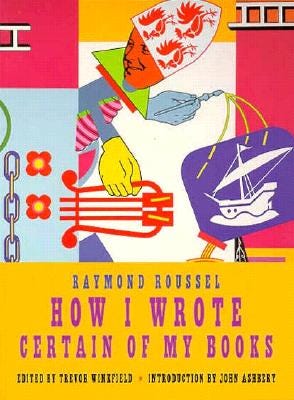
Roussel was born into an immensely wealthy Parisian family in 1877 (he died by suicide in 1933), the money surrounding him acting as a cocoon between himself and reality. The quotidian is notable by its absence from his work: this is not a literature with much appeal for anyone in search of a social conscience. But if one is magnetized by works of the imagination derived almost solely from linguistics, Roussel represents some kind of summation. How I Wrote Certain of My Books, the posthumously published testament in which Roussel delineates many—but by no means all—of his writing techniques is, as they say, essential reading. As a vade mecum it doesn’t necessarily make the books easier to penetrate, but it does provide some clue as to what lies beneath them (though no matter how knowledgeable these clues make us, as readers, feel, no amount of shouting “Open Sesame!” at the threshold of the books entices them to reveal all their secrets). The most obvious examples of his expository secrets can be found early in his career, before he learnt to cover his tracks. The story “Among the Blacks,” written during Roussel’s years of “prospecting” (as he termed his youth) begins and ends with two almost identical phrases: Les lettres du blanc sur les bandes du vieux billard (The white letters on the cushions of the old billiard table) and Les lettres du blanc sur les bandes du vieux pillard (The white man’s letters on the hordes of the old plunderer). Acting as a delicious sandwich between these apparently irreconcilable rhyming bookends comes a parlor game set in a country home. A question in writing is posed to someone who is then shut up in the adjoining room; after ten minutes one is released to give a response to the question in the form of a riddle whose flavor is perfectly captured by Ron Padgett’s hilariously deadpan translation:
First, there was a man’s face, split in half, the right side of which was utterly fiendish and ugly. This was followed by an eyeball, from which hung an L. Then came a skeleton key that was inserting itself into a 2. After this there was a stack of currency bills; the Greek letter for alpha; the words “The Chrononhotonthologos Man”; a cat, the incomplete group of words “—— — your rocker!”; a table setting that included a prominent frankfurter and a jar; and last, four zebras singing in unison, “We don’t want to zzzz!” After a moment of reflection, I had the complete sentence and I related it in detail while having the others follow on the drawing: HYDE L EYE KE TWO DOugh A CAREY CAT YOU’RE OFF MUSTARD ZEBRAS. And I repeated fluently, I’d like to do a caricature of Mister Debarras.
One finds this mixture of the “simple as ABC with the quintessential” (to quote Michel Leiris’s memorable definition) as either childish or brilliantly inventive. A Rousselian finds both attitudes acceptable.
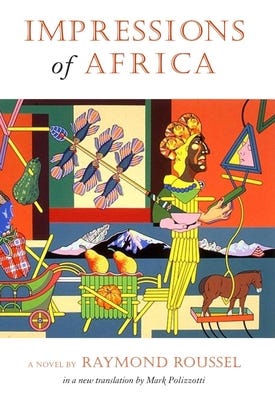
Such raiding of the nursery to conjure up adult myths produced Roussel’s first indisputable masterpiece, the novel Impressions of Africa, published in 1910 at the author’s expense (as were all his books) under the prestigious Lemerre imprint. It begins like a boy’s adventure story: a group of shipwrecked passengers are captured and held for ransom by an African king, Talou VII. To while away their time and keep their captors entertained, each captive is allotted a theatrical task or test of mechanical ingenuity based on his inherent skills, to be performed at a gala before their release. But in a reversal of the plot of Among the Blacks and in defiance of all the rules of detective fiction, Roussel first explains and then describes his mysteries, somewhat like the playwright who, in the opening scene, tells us who the murderer is and then spends the rest of the play explaining why he did it. Suspense is thus dispensed with at the opening of the adventure. But it remains one of his greatest triumphs as a storyteller that after all the mysteries have been unravelled and explained away, they become even more mysterious—hence his appeal to modernists and ourselves. A further aspect of his appeal resides in his manipulation of people. Not exactly as a puppet master, but one who shuffles his characters around to serve the same purpose as words, strictly to unfold the story. No one could be less interested in psychology than Roussel. The surface of things is paramount, characters being defined by their rituals and attributes, not their sonalities. Their belongings as a result can be more animistic than their owners.
And yet his characters—some of the most inventive in all twentieth-century literature—are elevated above the robot level with a few deft strokes of characterization. Take the unforgettable episode concerning the painting adventures of sexy Louise Montalescot (one of whose many singularities derives from a phonetic distortion of (slices) á canard (duck) into aiguillettes (shoulder braid of a uniform) á canard (false notes in music), thus supplying Roussel with her musical shoulder braid). Over the span of several pages we discover that she is a botanical explorer traveling with a younger brother, “the object of her warmest affection”; she has charm and allure, is both beautiful and captivating; she possesses “splendid fair hair, which she allowed to fall in natural curls below the small forage cap worn jauntily over one ear.” She’s adopted male attire for the tropics, specifically an officer’s uniform. Blessed with a serious demeanor, yet she preaches free love. None of these details is dwelt upon (in many ways they’re as cursory as stage directions), but bit by bit throughout the narrative they’re offered as clues to our protagonist’s persona: they leave us with an impression rather than a portrait, but it’s enough to make us care about the characters and about what they’re going to do next. And what Louise Montalescot does next is create a painting machine, a photo-mechanical contraption whose functioning is facilitated by the use of a rare tropical oil. Set in motion, it produces an unbelievably accurate and artistically satisfying facsimile of the garden arranged before it. No wonder Duchamp and Picabia, among numerous visual artists, extol this particular episode as one of the seminal turning points in their own lives. The whole book has a similar visual impact, like an illuminated manuscript patiently unscrolled by a professorial hand.
This notion of lives episodically unfolding “before our very eyes” is carried even further in Roussel’s second and final novel, Locus Solus, first published on the eve of World War I (his sole comment on that conflagration—“I’ve never seen so many men!”—being a mordant example of his blinkered humor) and for many of us his greatest, most perfect narrative construction. Set in the spacious grounds of Locus Solus, the “solitary place” inhabited by Martial Canterel, a wealthy scientific genius living on the outskirts of Paris, the novel’s form, even more so than that of Impressions, relies for its model on the travelogue. Here our guide actually is a professor, one who escorts his guests through his landscape of marvels. A partial tabulation of what his guests are asked to admire would include a curious, antique sculpture molded from dry earth of a naked child holding forth a wizened flower; an aerial paving beetle-cum-weather forecaster which builds a mosaic made from rotten teeth, guided thither and yon by the wind (whose movements Canterel has predicted days in advance). Further on, we come across a gigantic faceted aquarium containing a curious medley of objects and creatures, including a depilated cat who, aided by a pointed metal horn, galvanizes the floating remains of Danton’s head into speech; a dancer with musical tresses; and a troupe of bottle-imps performing scenes from folklore and history as they rise and fall through the oxygenated water. The central marvel, however, involves what amounts to a glass-enclosed graveyard where eight corpses are reanimated (thanks to Canterel’s preparations of vitalium and resurrectine) in order to relive the capital moments of their lives, attended by their ecstatically grieving (but still living) relatives.
This précis barely skims the surface of the novel’s layout, which, like that of Impressions, is delineated by descriptions, which in turn expand and engender other descriptions, followed by explanations of those descriptions. And such is the concision of Roussel’s language that itemizing all the episodes and their ramifications would entail a tabulation almost as detailed as the books themselves, ending up with something very much like Lewis Carroll’s lugubrious map, the one that’s so detailed it’s on a scale of one mile to one mile, thus completely covering the landscape it is intended to elucidate.
Roussel’s world, as portrayed in the two novels, is almost soundproof and virtually devoid of dialogue, with only the whirr of an aerostat or the presumed clatter from the blades of a hydraulic wheel to interrupt the mime. One suspects that almost as an act of revenge Roussel felt compelled to follow his two novels with two plays, The Star on the Forehead in 1925, followed two years later by Dust of Suns. These are plays in which people can’t stop talking . . . or is that babbling? Whatever it is, it’s more than mere verbiage they spout. Their speeches act as the plot’s propellant. Anecdotes are batted back and forth between characters like shuttlecocks, cleverly disguising the fact that a single narrator could conceivably deliver them as a monologue. Hilarious and deeply involving though both may be, these remain plays better read on the page than endured on the stage.
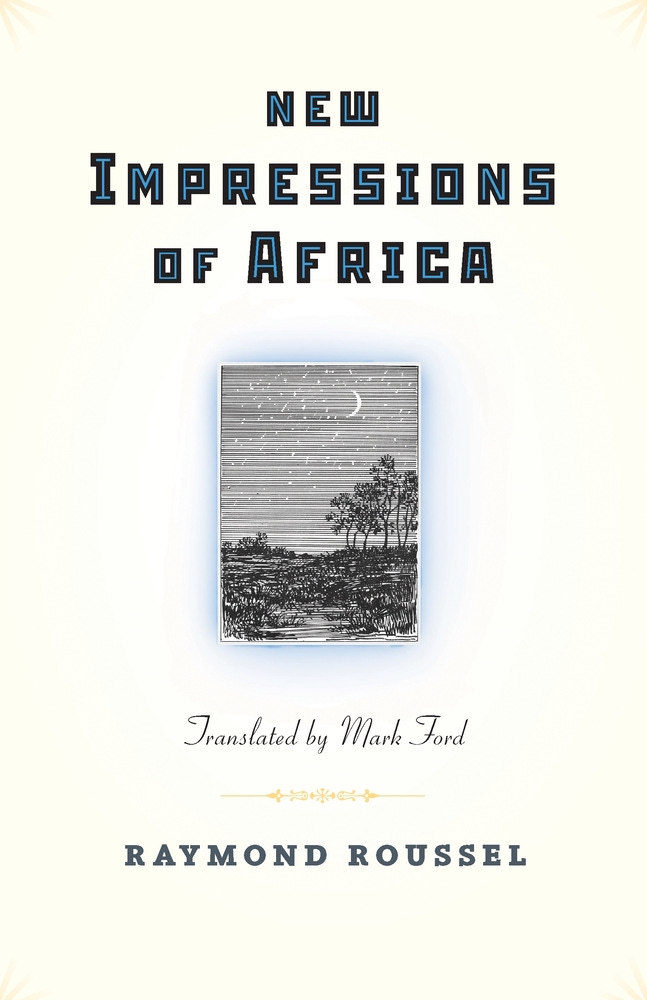
Roussel’s penultimate opus, New Impressions of Africa, is not, as its name seems to imply, a continuation of the earlier novel. Rather it is one of the most complex poems in the French language, four cantos based loosely on four Egyptian tourist sites. Not only is the text complex, it looks impenetrable. The layout proclaims “No Trespassing” to the casual reader, with its thicket of brackets within brackets within brackets and attendant footnotes as austere and foreboding as any Rosetta Stone. But once inside it reveals itself as even more impenetrable! For instance, the opening of the third canto (ostensibly extolling the virtues of a column on the outskirts of Damietta which, when licked, cures jaundice) is brought to a halt after only five lines by the mention of hope, leading to a parenthesis dealing with an American uncle whose nephews have hopes of inheritance. But that touching scene is not completed for five or six pages, the word “American” having provoked a double-parenthesis dealing with “that land still young, still unexhausted” whose dog’s cold nose triggers a trio of brackets and a brief revery on an ailing pup. Which in turn triggers a bracketed aside within four parentheses, then another within five. After barely one hundred lines, even the most astute and intrepid explorer is all at sea and gasping for air. This avalanche of interruptions is akin to that produced by a group of partygoers, with one conversationalist being interrupted barely after he’s begun talking; meantime his interrupter is in turn cut short by the person across the table whose memory has just been jolted, so she in turn relates an anecdote, which reminds her neighbor of a funny story . . . and so on and so forth. This simplistic exegesis of the technique is, I hope, sufficient to show that it’s not for readers cursed with a one-track mind. But to those who persevere, this Everest of High Modernism donates rich comfort: like all truly great works of art, it is inexhaustible in its rewards. The density of the language—its pared-down compression—is such that each line could be ascribed a physical weight as well as length. As Roussel himself said of an earlier version of this poem, abandoned after countless revisions, an entire lifetime would have been insufficient to complete the polishing. Likewise (and I know whereof I speak) an entire lifetime is insufficient to fully disentangle (and understand—my italics) its myriad branches. The same, of course, may be said of Roussel’s entire oeuvre.
This piece first appeared in issue No. 10 of CONTEXT. Copyright © Trevor Winkfield.
Selected Works by Raymond Roussel in Translation
Among the Blacks: Two Works
How I Wrote Certain of My Books and Other Writings (ed. Trevor Winkfield)
Impressions of Africa (tr. Mark Polizzotti)
Locus Solus (tr. Rupert Copeland Cunningham)
New Impressions of Africa (tr. Mark Ford)
"This simplistic exegesis of the technique is, I hope, sufficient to show that it’s not for readers cursed with a one-track mind. But to those who persevere, this Everest of High Modernism donates rich comfort: like all truly great works of art, it is inexhaustible in its rewards."
I think while this article certainly gives an impression of aspects of Roussel's technique, making it appear like a playful surreal ensemble, it somehow misses the work's deadening, thoroughly negating atmosphere. His endless mechanical agonies on replay, these ekphrases that seem never allowed to join up to to a homogenous surface impression seem (to me) thoroughly and consciously inaccessible by the kind of enthusiastic perseverance that the article seems to recommend. My reading experience made me sink to a low, sullen, and bleak point, a reading without hope or expectation. In that mode, the described elaborate mechanics of depiction seem to purposefully evade a mimetic reading. One glances at a stage where Roussel fitfully animates a corpse by a thousand threads; it is a corpse that has not quite begun to stink yet but there is something of an odor and a shine that foreshadows the decomposition. I feel Roussel's oeuvre is rendered a disservice when called a 'truly great work of art', or one that it 'donates rich comfort': if there is one thing that it will not do is give comfort (and, I imagine, never intended to). It refuses reward.